No Products in the Cart

This is the fire road adventure bike that Indian should have launched.
An ADV nav tower, carbon fairing, skid plate, racks and hard luggage. Custom designed for the Indian FTR 1200.


An ADV nav tower, carbon fairing, skid plate, racks and hard luggage. Custom designed for the Indian FTR 1200.
The first-generation FTR is a far more capable motorcycle than Indian let on. It holds a line through the twisties like a sportbike, and with nearly six inches of travel it goes further off pavement than most scramblers: fire roads, two-track, the national forest routes, the backcountry. It was always this bike.
It just shipped without the equipment.
These add-on parts keep it an FTR. You are not doing Black Bear Pass, and the GS probably is not either. But these custom components will let you explore a lot farther than you expected, with the wind off your chest and a week of gear on the back.
You keep the bike you bought because you loved how it looked, and you get the bike you wish you it had been all along.

Every part here was modeled to form a complete adventure kit for the Indian FTR. The ADV requirements for navigation, protection and luggage have all been addressed to give a capable platform the ability to go as far as you want to go.
 1234567
Limited production for the complete kit.
Protection under the engine, navigation with the weather protection, and somewhere to carry a week of gear. Get it all in one kit, or buy just what you need.


The first-generation FTR was begging for a high fender. It...
$130.00The skid plate is the first thing the FTR needs off pavement and the last thing you want to learn about the hard way.
The skid plate was designed to be low profile, and to hug the engine. It looks as good on the 17" wheel FTRs as it does on the FTR with fire roads in mind.
The luggage rack is what turns a day ride into a weekend. A solid place to mount a big duffle, or just tools in a small tail bag that you don’t want on the tank.
Panniers and luggage rack are not compatible with comfort or tracker seats. Panniers are not compatible with high exhaust.
Goes on in a weekend with hand tools. Fasteners included.
Nothing is cut or drilled and no wire is spliced. The stock parts go back on.
Made to order in Asheville, NC, and ships in two to four weeks.
30-days returns on unused parts. If a part arrives damaged or wrong, we make it right.
I'm an architect and designer, and I've been riding for thirty-five years. The FTR 1200 is one of the best-looking multi-purpose motorcycles built in decades. It has a style that is all its own, and a performance envelope wider than you’d expect. But it doesn’t travel well, and I like to ride. The parts I wanted didn't exist. So I designed my own.
Asheville, North Carolina
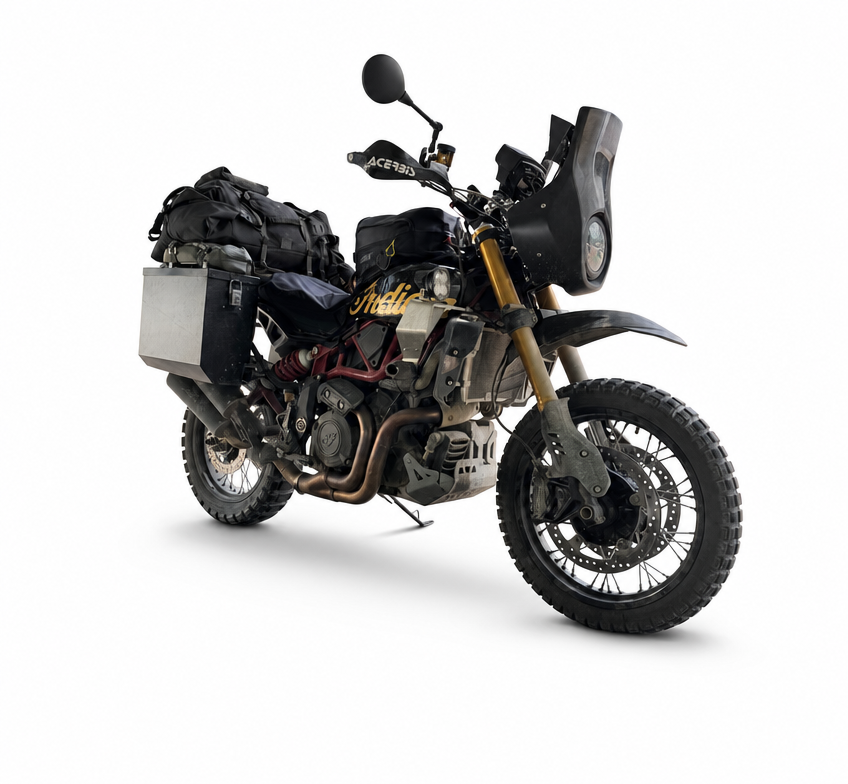
The fairing gives you cover, and a place for the nav and dash to sit where you can see them, and I think it looks better too. Like it is finished for some real travel. My bike fitted for adventure has carried me and my gear through backroads, trails and abandoned mountain service roads. And now I get to share it with those who want their FTR to do more.


Mid-Atlantic BDR · Pisgah · DuPont
The Roan Cowl, a carbon headlamp cowl built around Denali lighting. It remembers the early Dakar Ténérés and XTs, with pro-level lighting and room for a digital dash.
The same Roan Cowl on the Transalp's own clamp. It lightens the front of the bike and carries the Africa Twin twin-headlight face, in homage to the NXR750V.
A half fairing in the 1989 R100GS Paris-Dakar line, with a split mold, a CNC machined head clamp and twin headlights. It is the hardest thing on the list and the one I most want to build.

The touch points that turn an FTR into a two-track bike. Bars, pegs, seat and tires. If you didn't buy the Rally, these are the four places I'd start.

Moto-camping north and back again on fire roads and two-track, through stream crossings and up a few alt-harder climbs. One drop on Hite Hollow, no damage to the bike, and the kit came home intact.

The FTR's cockpit was designed for a flat tracker. Here is how the tower rebuilds it for a long day, using the stock headlight, and why the first one was laid up in a garage with a twenty-minute clock running.

In 1914 a man rode an Indian across America on roads that mostly did not exist. In 2019 Indian built the engine and chassis that could do it again, and stopped. This is why I picked up where they left off.
Sketching is how I learn and ask questions. Most of the time I do it for fun. A few of those questions turn into Fusion models and then into parts. A lot become illustrations on graphic tees, hoodies and mugs.


