

No Products in the Cart

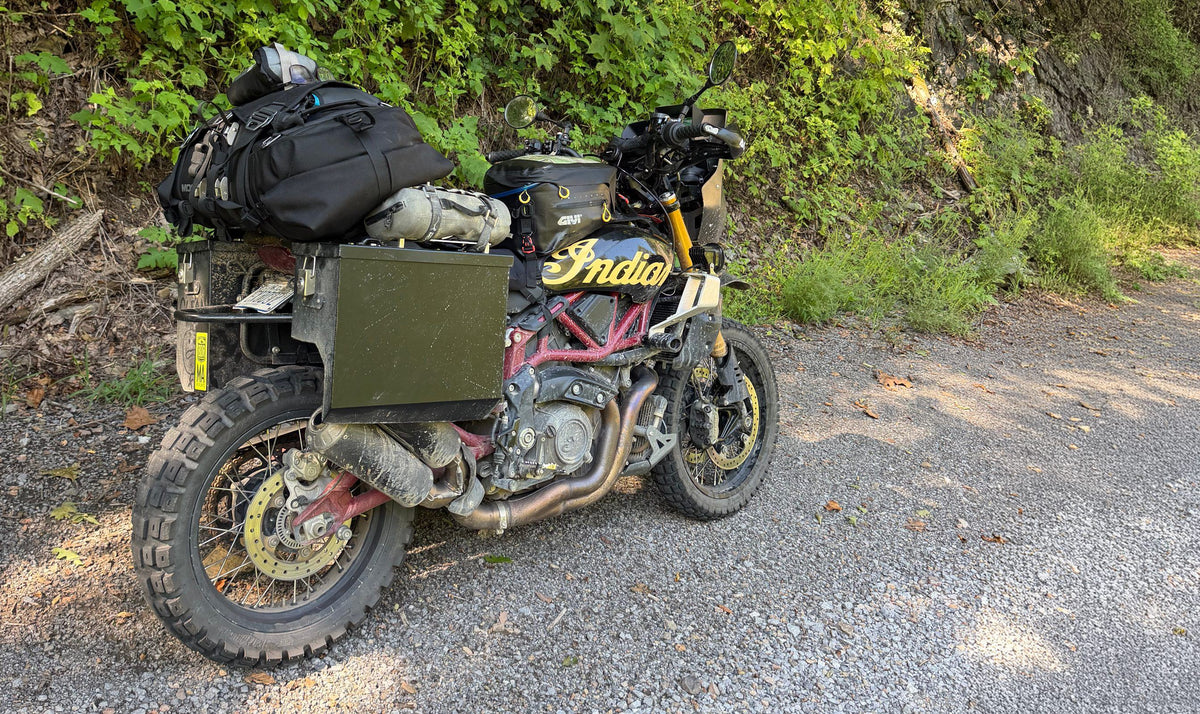
The Mid-Atlantic Backcountry Discovery Route runs 1,080 miles from Damascus, Virginia to the New York border, mostly on forest roads and rural lanes through Virginia, West Virginia, Maryland and Pennsylvania. I rode the northern part of the South-East BDR and the southern half of the MABDR both ways, to test the bike in what I consider its ideal environment. Fire roads and two-track off the beaten path for days. Second and third gear mountain passes. Some chunky climbs and Appalachian switchbacks. This is where I love to be, and this was the third round of prototypes going out to be tested. When I finish the crash bars I will take this bike up through the NEBDR for a level-up.
About 1,400 miles over six days. The full kit on the bike: nav tower, gauge relocator, 100 mm bar risers, skid plate, high fender (not really needed, but it looks right), luggage rack and both panniers. A skid plate that has been on a bike for an afternoon tells you nothing. A skid plate that has spent a week taking gravel ricochets, and keeping branches from whacking the battery and the electrical connectors behind it, tells you a true story.

What I was carrying
Left pannier: tent, air mattress, sleeping blanket, pillow, a Jetboil, a chair, an adventure medical kit and a few Mountain House meals. Right pannier: tools in an MSR bag, a second pouch with the allen and torx keys, a ratchet, tape, fuses and JB Weld, a recovery bag with tire irons, a moto crutch, an air pump and a bead buddy, and an inner tube. The right box is the medium Tusk aluminum pannier with a section cut out of the inside face for exhaust clearance, which is why the pannier system now ships with that cutout on the Akrapovic side.
Tank bag: three liters of water, spare gloves, a battery bank, visor cleaner, snacks. On the rack, a 40-liter soft bag with clothes, a laptop, shoes, a hoodie, the rain kit and tent pegs, with a gallon of water hanging off the back. Four liters of fuel. Zumo XT on the tower deck with the BDR track loaded as a track, and an inReach in the jacket pocket. Call it a week of gear. Preload jacked up to 325 pounds.
Northbound
Out of Asheville and up through the northern end of the SEBDR, then onto the MABDR proper. The route climbs in and out of valleys and along side-cut service roads. Loose fresh gravel, or just unmaintained rutty two-track. Long second and third gear climbs where the FTR is genuinely happy.
Rain on and off the first day, branches down and water cutting at the dirt ruts. I had not thought about the fairing since mid-morning, which means I did it right. The Zumo was up high where I could see the tracks seated or standing. And the pivoting gauge mount was right next to it. I could stand comfortably all day. My gear was protected and dry, and the skid plate kept crap from taking out my oil cooler line and those wires under the battery.

Hite Hollow was easy, it was the view that was tough
Day three northbound took me up Hite Hollow, north of Warm Springs. It is about ten miles of rock and dirt that climbs from Augusta Springs at roughly 1,600 feet to around 3,800 at the ridge and drops into the Deerfield valley on the other side, on switchbacks the whole way. It used to be an ALT Harder on the MABDR but it's part of the main route now.
I stopped on it and dropped the bike. Not at speed or on the climb avoiding steps. Just stopping to admire the view on a pitched rocky section where I forgot how much the road was leaning away from me. A loaded big bike is heavy, it turns out. I dropped it pointed uphill, so I had to drag it across the pannier over rocky ground to get it into a position I could lift from.
The panniers held the bike off the ground, but were scraped up on the edge dragging it. The luggage rack has a slight tweak I bent back. Fortunately the FTR keeps its fuel under the tank, and as long as the angle is right, the lift wasn't nearly as tragic as trying to pick up a taller Ténéré or something bigger like an Africa Twin.

Southbound
Running some of the same paths south, I added a few of the original MABDR sections to the track. Beautiful weather, long runs along Shenandoah ridges and valleys, and I was ecstatic about the ride.
Stream crossings at section 3 were no problem. Long stretches standing, with the bar risers letting me stay more upright, kept me in control and in comfort. The Motoz Rall-Z tires locked into the trails wet or dry.
What held
Everything in the kit held. Six days, about 1,400 miles, a week of gear, loose gravel, water crossings, a few alt-harder sections and one drop, and only the pannier rack had a slight tweak. The skid plate protected the sump, the cooler and the electricals. The panniers stayed square. The tower did not shake, which was the thing I was most worried about.
Now it is ready for those of you who hear the calling.
The parts and the illustration in this post


